

Every time a new vacancy is announced in Rochester’s ambitious retail venture known as College Town, more and more residents pile on to social media to rant about the project’s imminent failure. Surrounding lower class neighborhoods, a city that has one of the worst poverty rates in the nation and misuse of subsidies, among others, are cited reasons why this $100 million-plus mixed-use project is quickly being condemned as another in a long line of bad development decisions the city has entertained. To some extent, these are likely key components to College Town’s struggles.


The real struggle for any project like this, however, is one that very few people talk about. It is a lack of connective tissue to Rochester residents, University of Rochester Medical Center employees and U of R on-campus students who might utilize and patronize College Town’s establishments. It is a set of existing traffic barriers, surrounded by a sea of neighborhoods that are not likely to support the kind of businesses the facility houses. It is the false impression that if you back a dump truck of development money into an area that is not ready for it, it will instantly lift the neighborhood.


Geography & Demographics
College Town replaced a series of outdated administrative buildings on the East end of The University of Rochester Medical Center campus. In an attempt to visually enhance the area surrounding Rochester’s largest employer, as well as add vibrancy to an otherwise socioeconomically depressed area, College Town would be the welcoming face, ushering in University of Rochester students, as well as Medical Center employees.
But again, the problem facing this project began before it started… the surrounding neighborhoods range from $20,000 – $40,000 annual household income, with a few exceptions here and there. The poverty rate in these areas is also relatively high.
The Medical Center “backs up” to College Town making the two relatively close in proximity. A short 5 minute walk from almost anywhere on the Med Center campus will easily land you in the midst of the CT action. However, most of the parking for hospital employees is nowhere near the area. A huge percentage of employees are shuttled in from outlying parking lots miles away from College Town.


The University of Rochester college campus is a different story. With the assumption that students are far more likely to be on foot, the distance between on-campus student housing and College town is over a mile, taking approximately 25 minutes each way. Furthermore, this trek is along a stretch of Elmwood, a of 4-lane, 20,000+ daily traffic-count road that where cycling and pedestrian infrastructure and traffic calming features are inadequate at best.


While certainly possible, a walk along Elmwood is not a particularly inviting one. Pedestrians from the University campus could take the “long way” to College Town via Crittenden, which is very much a boulevard designed for walkability and cycling, but it adds time and distance to the route.
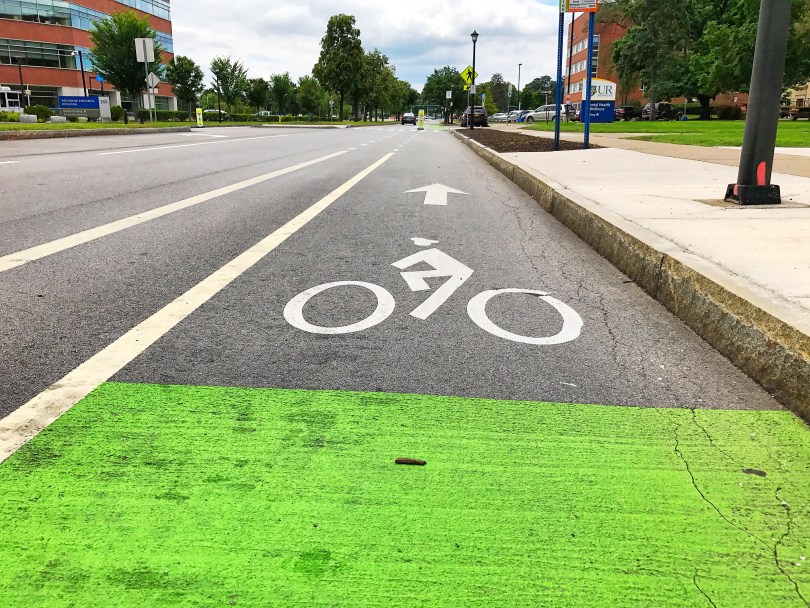
In any event, College Town is simply too far from the college campus to be an option for food in between classes or a quick bite to eat or a cup of coffee at Starbucks.
College Town is also located on the city fringe, about half way in between Center City Rochester and the busy, retail and chain restaurant super-giant suburb of Henrietta. Between Center City and CT is the popular lovable bohemian neighborhood, The South Wedge. “The Wedge,” and nearby Park Ave, are two of Rochester’s most popular shop and eat local destinations, with refurbished old buildings and unique houses, giving an authentic Rochester feel as you walk the streets. This is in stark contrast to the “just built” feel of College Town.
Remember Elmwood Ave? Elmwood crosses Mount Hope, another 20,000+ traffic count 4-lane road at College Town’s Northeast corner. This intersection, which I have crossed scores if not hundreds of times, acts as a pedestrian and cycling shield with an unwelcoming and at times dangerous feel for pedestrians. Crossing these streets, while possible, is less than pleasant, a big issue for an area that MUST rely on walkability to survive.
One more point on Mount Hope and Elmwood… these two streets/roads streak North/South and East/West respectively, funneling U of R employees and students from the surrounding neighborhoods into the area. Neither present a particularly hospitable pedestrian experience, and both are downright dangerous for cyclists with little or no shoulder, to say nothing about a designated bike lane.
Why The Above Matters
To be successful, College Town needs to have a blend of different groups of patrons. First and foremost, hospital employees and university students should be a huge piece of the CT business revenue. But offsite parking for hospital employees and a 25 minute hike for students via a street made for efficient car travel rather than a welcoming pedestrian experience likely causes both of these to come up short.
How about the surrounding neighborhoods? Low socioeconomic status and other, more affordable dining and beverage options exist in close proximity, and many of them have a much greater sense of local “flavor.”

The Future
Despite the failings mentioned above, College Town has some positives coming. Elmwood is not far away from being remade, complete with greatly improved pedestrian and cycling infrastructure.
RTS Bus Service has done all they can to increase their presence in college town with several new a shiny bus stops complete with digital screens, heat lamps and bike racks. However, like most U.S. cities, Rochester’s bus system predominantly serves its poorer residents, a demographic that is not likely to patronize the generally mid-to-higher-end experience College Town employs.
More construction in the area, including nearby City Gate and the ever-growing footprint that is the Medical Center will likely feed College Town’s future. But the infancy of College Town is a clear warning to the often-touted belief that large scale development projects alone can transform neighborhoods. Rather, a balance of proper multi-use connectivity with the rest of the area and an incremental development approach can lift an area slowly and sustainably without creating yet another “Money Island.”